Edward Snowden was interviewed over several days in
Hong Kong by Glenn Greenwald and Ewen MacAskill.
Q: Why did you decide to become a whistleblower?
A: "The
NSA
has built an infrastructure that allows it to intercept almost
everything. With this capability, the vast majority of human
communications are automatically ingested without targeting. If I wanted
to see your emails or your wife's phone, all I have to do is use
intercepts. I can get your emails, passwords, phone records, credit
cards.
"I don't want to live in a society that does these sort of
things … I do not want to live in a world where everything I do and say
is recorded. That is not something I am willing to support or live
under."
Q: But isn't there a need for surveillance to try to reduce the chances of terrorist attacks such as Boston?
A:
"We have to decide why terrorism is a new threat. There has always been
terrorism. Boston was a criminal act. It was not about surveillance
but good, old-fashioned police work. The police are very good at what
they do."
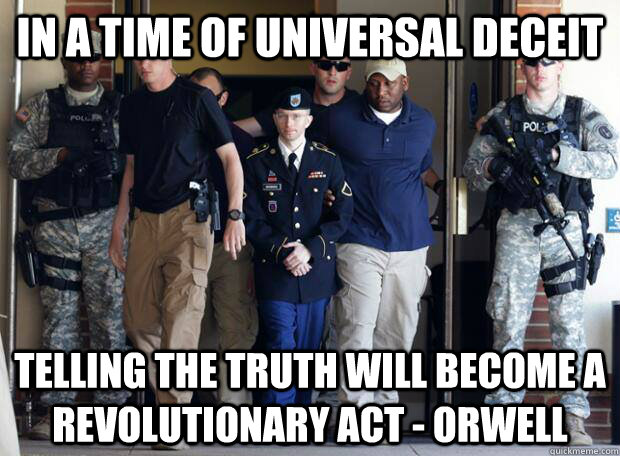
Q: Do you see yourself as another Bradley Manning?
A: "Manning was a classic whistleblower. He was inspired by the public good."
Q: Do you think what you have done is a crime?
A:
"We have seen enough criminality on the part of government. It is
hypocritical to make this allegation against me. They have narrowed the
public sphere of influence."
Q: What do you think is going to happen to you?
A: "Nothing good."
Q: Why Hong Kong?
A:
"I think it is really tragic that an American has to move to a place
that has a reputation for less freedom. Still, Hong Kong has a
reputation for freedom in spite of the People's Republic of China. It
has a strong tradition of free speech."
Q: What do the leaked documents reveal?
A:
"That the NSA routinely lies in response to congressional inquiries
about the scope of surveillance in America. I believe that when [senator
Ron] Wyden and [senator Mark] Udall asked about the scale of this, they
[the NSA] said it did not have the tools to provide an answer. We do
have the tools and I have maps showing where people have been
scrutinised most. We collect more digital communications from America
than we do from the Russians."
Q: What about the Obama administration's protests about hacking by China?
A:
"We hack everyone everywhere. We like to make a distinction between us
and the others. But we are in almost every country in the world. We are
not at war with these countries."
Q: Is it possible to put security in place to protect against state surveillance?
A:
"You are not even aware of what is possible. The extent of their
capabilities is horrifying. We can plant bugs in machines. Once you go
on the network, I can identify your machine. You will never be safe
whatever protections you put in place."
Q: Does your family know you are planning this?
A:
"No. My family does not know what is happening … My primary fear is
that they will come after my family, my friends, my partner. Anyone I
have a relationship with …
I will have to live with that for the
rest of my life. I am not going to be able to communicate with them.
They [the authorities] will act aggressively against anyone who has
known me. That keeps me up at night."
Q: When did you decide to leak the documents?
A:
"You see things that may be disturbing. When you see everything you
realise that some of these things are abusive. The awareness of
wrong-doing builds up. There was not one morning when I woke up [and
decided this is it]. It was a natural process.
"A lot of people
in 2008 voted for Obama. I did not vote for him. I voted for a third
party. But I believed in Obama's promises. I was going to disclose it
[but waited because of his election]. He continued with the policies of
his predecessor."
Q: What is your reaction to Obama
denouncing the leaks on Friday while welcoming a debate on the balance
between security and openness?
A: "My immediate reaction
was he was having difficulty in defending it himself. He was trying to
defend the unjustifiable and he knew it."
Q: What about the response in general to the disclosures?
A:
"I have been surprised and pleased to see the public has reacted so
strongly in defence of these rights that are being suppressed in the
name of security. It is not like Occupy Wall Street but there is a
grassroots movement to take to the streets on July 4 in defence of the
Fourth Amendment called Restore The Fourth Amendment and it grew out of
Reddit. The response over the internet has been huge and supportive."
Q: Washington-based foreign affairs analyst Steve Clemons said he overheard
at the capital's Dulles airport four men discussing an intelligence
conference they had just attended. Speaking about the leaks, one of them
said, according to Clemons, that both the reporter and leaker should be
"disappeared". How do you feel about that?
A: "Someone responding to the story said 'real spies do not
speak like that'. Well, I am a spy and that is how they talk. Whenever
we had a debate in the office on how to handle crimes, they do not
defend due process – they defend decisive action. They say it is better
to kick someone out of a plane than let these people have a day in
court. It is an authoritarian mindset in general."
Q: Do you have a plan in place?
A:
"The only thing I can do is sit here and hope the Hong Kong government
does not deport me … My predisposition is to seek asylum in a country
with shared values. The nation that most encompasses this is Iceland.
They stood up for people over internet freedom. I have no idea what my
future is going to be.
"They could put out an Interpol note. But I
don't think I have committed a crime outside the domain of the US. I
think it will be clearly shown to be political in nature."
Q: Do you think you are probably going to end up in prison?
A:
"I could not do this without accepting the risk of prison. You can't
come up against the world's most powerful intelligence agencies and not
accept the risk. If they want to get you, over time they will."
Q: How to you feel now, almost a week after the first leak?
A:
"I think the sense of outrage that has been expressed is justified. It
has given me hope that, no matter what happens to me, the outcome will
be positive for America. I do not expect to see home again, though that
is what I want."