Showing posts with label alfred korzybski. Show all posts

Monday, April 22, 2013

Reality Model Playground!


Check out this awesome new blog!!! 

From the info:
"I created this blog as a place to store and share the models of reality I enjoy exploring. I don't believe totally in anything, a concept introduced to me by Robert Anton Wilson, freeing me to consciously create my own reality tunnel.
     
          The images here were created by me using my art & photography."

More cool art, images & quotes at the blog!


Wednesday, June 3, 2009

Robert Anton Wilson - TSOG Maybe


Robert Anton Wilson - TSOG Maybe

From the vid info: Perhaps instead of thinking of things changing, it may be more accurate to think of change as 'thinging'. Change 'thinging' in a process-oriented universe. The universe we are living in today is not the same universe we were living in yesterday. Scenario Universe consists of non-simultaneously apprehended events. I seem to be a verb. I have never met a noun.

"The aim of education is the condition of suspended judgment on everything."
- George Santayana

"Learning to un-learn to learn, for me, best describes the process of learning the discipline theoretically (verbally) and organismically."
M. Kendig

"Teaching and learning that lead to no significant change in behavior are practically worthless."
Irving Lee

"There are two ways to slide easily through life: Namely, to believe everything, or to doubt everything; both ways save us from thinking."
- Alfred Korzybski

"A person does what he does because he sees the world as he sees it."
- Alfred Korzybski

"You can't step into the same river twice."
- Heraclitus

"As far as the laws of mathematics refer to reality, they are not certain, and as far as they are certain, they do not refer to reality."
- Albert Einstein

"We see the world as 'we' are, not as 'it' is; because it is the "I" behind the 'eye' that does the seeing."
- Anais Nin

"All our knowledge has its origins in our perceptions."
- Leonardo da Vinci

"Who rules our symbols, rules us."
- Alfred Korzybski

"How could youths better learn to live than by at once trying the experiment of living?"
- Henry David Thoreau

Tuesday, June 2, 2009

Robert Anton Wilson talks about Alfred Korzybski, Friedrich Nietzsche,...


Robert Anton Wilson talks about Alfred Korzybski, Friedrich Nietzsche,... (Check out Discordian420's channel)

In this clip, Robert Anton Wilson talks about the influence of Alfred Korzybski, Friedrich Nietzsche, Benjamin Tucker, Karl Popper, Timothy Leary, Harry Stack Sullivan, Eric Berne, Wilhelm Reich, and James DeMeo on his books and ideas.
"There is nothing rationally desirable that cannot be achieved sooner if rationality itself increases. Work to achieve Intelligence Intensification is work to achieve all our sane and worthwhile goals." -Robert Anton Wilson

Saturday, November 1, 2008

Robert Anton Wilson: Language and Reality


Robert Anton Wilson: Language and Reality 1 & the rest

Discussing Language, Reality, Korzybski, Burroughs, Leary, LSD, James Joyce, sematics, syntax, semiotics, etc. Like this post on the 8 Circuit Model, this fascinating audio series from the audiobook "RAW Explains Everything (Or old bob exposes his Ignorance)." Here are all the (audio) vids.

Thursday, October 16, 2008

Robert A. Heinlein Quotes

Robert Anson Heinlein (July 7, 1907 – May 8, 1988) was an American novelist and science fiction writer. Often called "the dean of science fiction writers", he is one of the most popular, influential, and controversial authors of "hard science fiction". He set a high standard for science and engineering plausibility and helped to raise the genre's standards of literary quality. He was the first writer to break into mainstream with unvarnished science fiction. He was among the first authors of bestselling, novel-length science fiction in the modern, mass-market era. For many years, Heinlein, Isaac Asimov, and Arthur C. Clarke were known as the "Big Three" of science fiction. Check the rest of the wiki, he was influenced by Alfred Korzybski too. Quotes:

Belief gets in the way of learning.

Being intelligent is not a felony. But most societies evaluate it as at least a misdemeanor.

No intelligent man has any respect for an unjust law.

Secrecy is the beginning of tyranny.

Anyone can see a forest fire. Skill lies in sniffing the first smoke.

The whole principle is wrong. It's like demanding that grown men live on skim milk because the baby can't have steak. (On censorship)

An elephant is a mouse built to government specifications.

Men rarely (if ever) manage to dream up a god superior to themselves. Most gods have the manners and morals of a spoiled child.

Never underestimate the power of human stupidity.

A generation which ignores history has no past — and no future.

Democracy is based on the assumption that a million men are wiser than one man. How's that again? I missed something.
Autocracy is based on the assumption that one man is wiser than a million men. Let's play that over again, too. Who decides?

A competent and self-confident person is incapable of jealousy in anything. Jealousy is invariably a symptom of neurotic insecurity.

Most "scientists" are bottle washers and button sorters.

One man's theology is another man's belly laugh.

Never do today what you can put off till tomorrow if tomorrow might improve the odds.

Taxes are not levied for the benefit of the taxed.

Progress is made by lazy men looking for easier ways to do things.

If you pray hard enough, water will run uphill. How hard? Why, hard enough to make water run uphill, of course!

Sin lies only in hurting others unnecessarily. All other "sins" are invented nonsense.

There is no worse tyranny than to force a man to pay for what he does not want merely because you think it would be good for him.

Love is that condition in which the happiness of another person is essential to your own.

Humans hardly ever learn from the experience of others. They learn - when they do, which isn't often - on their own, the hard way.

The capacity of the human mind for swallowing nonsense and spewing it forth in violent and repressive action has never yet been plumbed.

A touchstone to determine the actual worth of an "intellectual"- find out how he feels about astrology.

Women and cats will do as they please, and men and dogs should relax and get used to the idea.

How can I possibly put a new idea into your heads, if I do not first remove your delusions?

Never appeal to a man's "better nature." He may not have one. Invoking his self-interest gives you more leverage.

I also think there are prices too high to pay to save the United States. Conscription (Mandatory Military Service) is one of them. Conscription is slavery, and I don't think that any people or nation has a right to save itself at the price of slavery for anyone, no matter what name it is called. We have had the draft for twenty years now; I think this is shameful. If a country can't save itself through the volunteer service of its own free people, then I say: Let the damned thing go down the drain!

A brute kills for pleasure. A fool kills from hate.

More Quotes here

Saturday, August 23, 2008

Robert Anton Wilson's Quantum Psychology

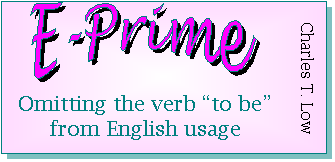
Robert Anton Wilson's Quantum Psychology: How Brain Software programs You and Your World (read and download here) focuses primarily on the metaphysical and epistemological problems of Aristotelean reasoning and its use in everyday language, covering E-Prime and how it addresses many of the semantic (and resulting perceptual) "spooks" that common language lets in.

It also covers psychosomatic healing and a possible explanation for it; non-local effects in quantum physics (Bell's Theorem) and the theories of David Bohm; and a brief recap of the Timothy Leary eight-fold consciousness theory of human consciousness which Prometheus Rising covers in much greater detail.

Check out an excerpt E and E-prime:

In 1933, in Science and Sanity, Alfred Korzybski proposed that we should abolish the "is of identity" from the English language. (The "is of identity" takes the form X is a Y. e.g., "Joe is a Communist," "Mary is a dumb file-clerk," "The universe is a giant machine," etc.) In 1949, D. David Bourland Jr. proposed the abolition of all forms of the words "is" or "to be" and the Bourland proposal (English without "isness") he called E-Prime, or English-Prime.

A few scientists have taken to writing in E-Prime (notable Dr. Albert Ellis and Dr. E.W. Kellogg III). Bourland, in a recent (not-yet-published) paper tells of a few cases in which scientific reports, unsatisfactory to sombunall members of a research group, suddenly made sense and became acceptable when re-written in E-Prime. By and large, however, E-Prime has not yet caught on either in learned circles or in popular speech. Read on

Sunday, June 1, 2008

Aiwazz saying, would you like some awesome ebooks?

Aiwazzsaying has a crazy collection of awesome ebooks. The Adam Weishaupt pic is kinda disturbing though, here's a quote "Oh, foolish man, what can you not be made to believe?" Perhaps it's a warning to keep thinking. Check out Captain Marginal's other blogs too.

Authors include: G.I. Gurdjieff, PD Ouspensky, John Lilly, Terence McKenna, Aleister Crowley, Kenneth Grant, Christopher S. Hyatt, Israel Regardie, R. Buckminster Fuller, Alfred Korzybski, Robert Anton Wilson, Timothy Leary, and many more.

To download I suggest using the megaupload link (left click only).

This is from that blog too: The Ten Command-Rants!


Click for larger version.
Thanks to Rabbi Lamed Ben Clifford, and to Lon Milo DuQuette. (Supposed Illuminati Whistleblower Leo Zagami said in a recent interview (with possible disinfo-project Camelot... :p) Lon Milo DuQuette has been 'bought', I don't know about either person enough to make anything out of this, and yes I do appreciate the humor between everyone accusing everyone, it's fun.)
update: Lon Milo DuQuette dropped by in the comments.

Thursday, May 15, 2008

Living with Magick Quotes

The first step to expanding your reality is to discard the tendency to exclude things from possibility.
— Meridjet

There are two ways to slide easily through life: to believe everything or to doubt everything. Both ways save us from thinking.
— Alfred Korzybski

If you don’t know where you are going, any path will get you there.
— Lewis Carroll

The greatest discovery of my generation is that a human being can alter his life by altering his attitudes of mind.
— William James

An optimistic mindset finds dozens of possible solutions for every problem that the pessimist regards as incurable.
— Robert Anton Wilson

Love is like a friendship caught on fire. In the beginning, a flame, very pretty, often hot and fierce, but still only light and flickering. As love grows older, our hearts mature and our love becomes as coals, deep-burning and unquenchable.
— Bruce Lee

For one man or one institution to claim that there is only one true way to godhood is an insult to the god they represent, because they have reduced Its omnipotence and omnipresence to the scope of their own minds.
— Gerald del Campo

First there is a mountain. Then there is no mountain. Then there is.
— Zen koan

Limitations live only in our minds. But if we use our imaginations, our possibilities become limitless.
— Jamie Paolinetti

The deeper that sorrow carves into your being, the more joy you can contain.
— Kahlil Gibran

No matter how painful [an] ordeal may be, it must be treated as an adventure. Keep in mind that, up until this point, every ordeal’s purpose has been to prepare you for the kind of life you are now living. See where current circumstances are leading you, and how they are changing your life, and use this information to find out where you are going. It is an honor to know that you have been worthy of instruction. Remember that you placed yourself where you are now. Remember the ancient dictum: “I will interpret every phenomenon as a particular dealing of God with my Soul.”
— Gerald del Campo

Thanks Living with Magick

Friday, April 18, 2008

New Robert Anton Wilson page

New Dedroidify page: Robert Anton Wilson
Featuring all on-site links, quotes and the Cosmic Trigger excerpt on Belief Systems.

RAW was a futurist, novelist, scientific philosopher, libertarian and a Ph.D in psychology. He's written many great works of fiction and non-fiction. In a 2003 interview with High Times magazine, RAW described himself as a "Model Agnostic" which he says "consists of never regarding any model or map of Universe with total 100% belief or total 100% denial. Following Korzybski, I put things in probabilities, not absolutes... My only originality lies in applying this zetetic attitude outside the hardest of the hard sciences, physics, to softer sciences and then to non-sciences like politics, ideology, jury verdicts and, of course, conspiracy theory."
More simply, he claims 'not to believe anything,' since 'belief is the death of thought.' Wilson described his writing as an "attempt to break down conditioned associations—to look at the world in a new way, with many models recognized as models or maps and no one model elevated to the Truth.

"My goal is to try to get people into a state of generalized agnosticism, not agnosticism about God alone, but agnosticism about everything." - Click here to jump to more quotes and this article on Belief Systems.

"Various medical authorities swarm in and out of here predicting I have between two days and two months to live. I think they are guessing. I remain cheerful and unimpressed. I look forward without dogmatic optimism but without dread. I love you all and I deeply implore you to keep the lasagna flying. Please pardon my levity, I don't see how to take death seriously. It seems absurd."

"Whatever the Thinker thinks, the Prover will prove. And if the Thinker thinks passionately enough, the Prover will prove the thought so conclusively that you will never talk a person out of such a belief, even if it is something as remarkable as the notion that there is a gaseous vertebrate of astronomical heft ("GOD") who will spend all eternity torturing people who do not believe in his religion."

Wednesday, April 16, 2008

Robert Anton Wilson: Cosmic Trigger Excerpt

Preface to the Falcon Press Edition, 1986
Cosmic Trigger was originally published by And/Or Press about ten years ago, and by Pocket Books shortly thereafter. Although some of my novels have sold far better, in two dimensions at least it is my most "successful" book in human terms.

1. From the date of the first printing to the present, I have received more mail about Cosmic Trigger than about anything else I ever wrote, and most of this mail has been unusuallly intelligent and open-minded. For some reason, many readers of this book think they can write to me intimately and without fear, about subjects officially Taboo in our society. I have learned a great deal from the correspondence, and have met some wonderful new friends.

2. On lecture tours, I am always asked more questions about this book than about all my other works together.

This new edition presents an opportunity to answer the most frequent questions and to correct the most persistent misunderstandings.

It should be obvious to all intelligent readers (but curiously is not obvious to many) that my viewpoint in this book is one of agnosticism. The word "agnostic" appears explicitly in the prologue and the agnostic attitude is revealed again and again in the text, but many people still think I "believe" some of the metaphors and models employed here. I therefore want to make it even clearer than ever before that
I DO NOT BELIEVE ANYTHING

This remark was made, in these very words, by John Gribbin, physics editor of New Scientist magazine, in a BBC-TV debate with Malcolm Muggeridge, and it provoked incredulity on the part of most viewers. It seems to be a hangover of the medieval Catholic era that causes most people, even the educated, to think that everybody must "believe" something or other, that if one is not a theist, one must be a dogmatic atheist, and if one does not think Capitalism is perfect, one must believe fervently in Socialism, and if one does not have blind faith in X, one must alternatively have blind faith in not-X or the reverse of X.

My own opinion is that belief is the death of intelligence. As soon as one believes a doctrine of any sort, or assumes certitude, one stops thinking about that aspect of existence. The more certitude one assumes, the less there is left to think about, and a person sure of everything would never have any need to think about anything and might be considered clinically dead under current medical standards, where absence of brain activity is taken to mean that life has ended.

My attitude is identical to that of Dr. Gribbin and the majority of physicists today, and is known in physics as "the Copenhagen Interpretation," because it was formulated in Copenhagen by Dr. Niels Bohr and his co-workers c. 1926-28. The Copenhagen Interpretation is sometimes called "model agnosticism" and holds that any grid we use to organize our experience of the world is a model of the world and should not be confused with the world itself. Alfred Korzybski, the semanticist, tried to popularize this outside physics with the slogan, "The map is not the territory." Alan Watts, a talented exegete of Oriental philosophy, restated it more vividly as "The menu is not the meal."

Belief in the traditional sense, or certitude, or dogma, amounts to the grandiose delusion, "My current model" -- or grid, or map, or reality-tunnel -- "contains the whole universe and will never need to be revised." In terms of the history of science and knowledge in general, this appears absurd and arrogant to me, and I am perpetually astonished that so many people still manage to live with such a medieval attitude.

Cosmic Trigger deals with a process of deliberately induced brain change through which I put myself in the years 1962-1976. This process is called "initiation" or "vision quest" in many traditional societies and can loosely be considered some dangerous variety of self-psychotherapy in modern terminology. I do not recommend it for everybody, and I think I obtained more good results than bad ones chiefly because I had been through two varieties of ordinary psychotherapy before I started my own adventures and because I had a good background in scientific philosophy and was not inclined to "believe" any astounding Revelations too literally.

Briefly, the main thing I learned in my experiments is that "reality" is always plural and mutable.

Since most of Cosmic Trigger is devoted to explaining and illustrating this, and since I still encounter people who have read all my writings on this subject and still do not understand what I am getting at, I will try again in this new Preface to explain it ONE MORE TIME, perhaps more clearly than before.

"Reality" is a word in the English language which happens to be (a) a noun and (b) singular. Thinking in the English language (and in cognate Indo-European languages) therefore subliminally programs us to conceptualize "reality" as one block-like entity, sort of like a huge New York skyscraper, in which every part is just another "room" within the same building. This linguistic program is so pervasive that most people cannot "think" outside it at all, and when one tries to offer a different perspective they imagine one is talking gibberish.

The notion that "reality" is a noun, a solid thing like a brick or a baseball bat, derives from the evolutionary fact that our nervous systems normally organize the dance of energy into such block-like "things," probably as instant bio-survival cues. Such "things," however, dissolve back into energy dances -- processes or verbs -- when the nervous system is synergized with certain drugs or transmuted by yogic or shamanic exercises or aided by scientific instruments. In both mysticism and physics, there is general agreement that "things" are constructed by our nervous systems and that "realities" (plural) are better described as systems or bundles of energy functions.

So much for "reality" as a noun. The notion that "reality" is singular, like a hermetically sealed jar, does not jibe with current scientific findings which, in this century, suggest that "reality" may better be considered as flowing and meandering, like a river, or interacting, like a dance or evolving, like life itself.

Most philosophers have known, at least since around 500 B.C., that the world perceived by our senses is not "the real world" but a construct we create -- our own private work of art. Modern science began with Galileo's demonstration that color is not "in" objects but "in" the interaction of our senses with objects. Despite this philosophic and scientific knowledge of neurological relativity, which has been more clearly demonstrated with each major advance in instrumentation, we still, due to language, think that behind the flowing, meandering, inter-acting, evolving universe created by perception is one solid monolithic "reality" hard and crisply outlined as an iron bar.

Quantum physics has undermined that Platonic iron-bar "reality" by showing that it makes more sense scientifically to talk only of the inter-actions we actually experience (our operations in the laboratory) ; and perception psychology has undermined the Platonic "reality" by showing that assuming it exists leads to hopeless contradictions in explaining how we actually perceive that a hippopotamus is not a symphony orchestra.

The only "realities" (plural) that we actually experience and can talk meaningfully about are perceived realities, experienced realities, existential realities -- realities involving ourselves as editors -- and they are all relative to the observer, fluctuating, evolving, capable of being magnified and enriched, moving from low resolution to hi-fi, and do not fit together like the pieces of a jig-saw into one single Reality with a capital R. Rather, they cast illumination upon one another by contrast, like the paintings in a large museum, or the different symphonic styles of Haydn, Mozart, Beethoven, and Mahler.

Alan Watts may have said it best of all: "The universe is a giant Rorschach ink-blot." Science finds one meaning in it in the 18th Century, another in the 19th, a third in the 20th; each artist finds unique meanings on other levels of abstraction; and each man and woman finds different meanings at different hours of the day, depending on the internal and external environments.

Read the rest of this great excerpt here at RAW's official website.

I just have to post the ending too cause it's too good:

Finally as a matter of some entertainment value, not all the mail I have received about this book has been intelligent and thoughtful. I have recieved several quite nutty and unintentionally funny poison-pen letters from two groups of dogmatists -- Fundamentalist Christians and Fundamentalist Materialists.

The Fundamentalist Christians have told me that I am a slave of Satan and should have the demons expelled with an exorcism. The Fundamentalist Materialists inform me that I am a liar, a charlatan, fraud and scoundrel. Aside from this minor difference, the letters are astoundingly similar. Both groups share in the same crusading zeal and the same total lack of humor, charity, and common human decency.

These intolerable cults have served to confirm me in my agnosticism by presenting further evidence to support my contention that when dogmas enter the brain, all intellectual activity ceases.

Sunday, April 6, 2008

Daily Dedroidify: Language

Daily Dedroidify: Language
  • Random Quotes
  • E-Prime: abolishing 'to be'
  • Alan Watts on nouns & things
  • Alan Watts on symbols & meaning
  • Unconscious mind does not process negation
  • Terence Mckenna: evolution of language
  • Terence Mckenna on visible language (vid)
  • Sanskrit: What is Maya?

  • Just a teaser post with excerpts. So I included the sublinks here too.

    Quotes

    You change all the lead sleeping in my head (to gold)
    as the day grows dim I hear you sing a golden hymn
    the song I've been trying to sing!
    Arcade Fire

    The only thing that you keep changing is your name,
    my love keeps growing still the same.
    Arcade Fire

    "Animals only suffer physical pain; humans suffer both physical pain and an additional psychological pain from the thought (verbal construct), 'I should not have to suffer this.' This causes us to struggle for social progress, better medicine etc. but it also causes us to feel the same bitter sense of 'injustice' or 'wrongness' when there is nothing concretely that can be done to ease the pain. In short, without language we'd have less suffering and no progress."
    Robert Anton Wilson

    "The basic tool for the manipulation of reality is the manipulation of words. If you can control the meaning of words, you can control the people who must use the words."
    Philip K. Dick

    "By and large, language is a tool for concealing the truth."
    George Carlin

    "Language shapes the way we think, and determines what we can think about."
    Benjamin Lee Whorf

    "Language helps form the limits of our reality."
    Dale Spender

    "The aim of the work of Aristotle and the work of the non-aristotelians is similar, except for the date of our human development and the advance of science. The problem is wether we shall deal with science and scientific methods of 350 B.C. or of today. In general-semantics, in building up a non-aristotelian system, the aims of Aristotle are preserved yet scientific methods are brought up to date."
    Alfred Korzybski

    E-Prime
    "'Is', 'is'. 'is' - the idiocy of the word haunts me. If it were abolished, human thought might begin to make sense.
    I don't know what anything 'is'; I only know how it seems to me at this moment." (The Historical Illuminatus as spoken by Sigismundo Celine)
    Any proposition containing the word "is" creates a linguistic structural confusion which will eventually give birth to serious fallacies.

    E-Prime is abolishing all forms of the verb "to be" from the English Language.
    Why? Because nothing 'is' and everything changes.
    A conversation tends to get a lot less aggressive & retarded when you say for example 'it seems to me...' instead of 'it is'.
    When you say something 'is', it only 'is' according to you - so why not say it like it 'is' ;) and express yourself more consciously?

    eg:
    1A. The electron is a wave.
    1B. The electron appears as a wave when measured with instrument-l.

    2A. The electron is a particle.
    2B. The electron appears as a particle when measured with instrument-2.

    3A. John is lethargic and unhappy.
    3B. John appears lethargic and unhappy in the office.
    etc

    Alan Watts on 'nouns & things'

    And so what I would call a basic problem we've got to go through first, is to understand that there are no such things as things. That is to say separate things, or separate events. That that is only a way of talking. If you can understand this, you're going to have no further problems. I once asked a group of high school children 'What do you mean by a thing?' First of all, they gave me all sorts of synonyms. They said 'It's an object,' which is simply another word for a thing; it doesn't tell you anything about what you mean by a thing. Finally, a very smart girl from Italy, who was in the group, said 'a thing is a noun.' And she was quite right. A noun isn't a part of nature, it's a part of speech. There are no nouns in the physical world.
    There are no separate things in the physical world, either. The physical world is wiggly. Clouds, mountains, trees, people, are all wiggly. And only when human beings get to working on things--they build buildings in straight lines, and try to make out that the world isn't really wiggly. But here we are, sitting in this room all built out of straight lines, but each one of us is as wiggly as all get-out.

    from 'The Nature of Consciousness'

    Alan Watts on 'symbols & meaning'

    Matter comes from the Sanskrit word 'matr' which means to measure. Lay out say the foundations say for a building, so we get to 'maya', and maya is generally translated illusion, although it also means magic, creative power.

    The word illusion, switch over, we get that from Latin and that comes from 'ludere;' to play (note from webmaster: and survives in english as 'lewd' :p). Let's pretend that we matter, haha! And so also from the root matr, you get 'mitar,' that is also to measure, you get 'meter' in Greek, 'mater' in Latin, which means mother, the mother of Buddha was called Maya. Marie, 'ma' again is the mother of Jesus, ma ma ma ma ma!

    But 'ma', you see, is a matter of form, pattern. The Chinese call the basic principle of nature 'li', and the character for 'li' means the markins in jade, the fibre in muscle, the grain in wood. So organic pattern. And that what's going on, and there's no stuff involved, what stuff is, is a pattern seen out of focus, where it becomes fuzzy, like kapok, kapok is the stuffing of a cushion, and that stuff is seen like goo, but when we examine the kapoc closely, we find structure, that's what you'll find and there never will be anything else. Crazy because it completely flouts our common sense!

    We say but surely, when philosophers beat tables that are in front of them, and they say it is there, bang, you know. It must be something that is stuff that is substantial. The only reason you can't move your hand through a table because the table is moving too fast. Haha. It's like trying to put your fingers through an electric fan, only it's going much faster than an electric fan. Anything solid is going so fast, that there is no way to get this trhough it. That's all. So you say what is it that's going so fast, well that question is based on a grammatical illusion, the grammatical illusion is that all verbs have to have subjects. Can you imagine anything more weird than the idea that a verb or an action or event, must be set into motion by a noun. A non-event or thing.

    What's the difference between a thing and an event, I can't for the life of me tell! We say this is a fist, that's a noun. What happens to it when I open my hand, this thing is unaccountably dissapeared, so I should call this a fisting, and this is a handing. It may also be a pointing. So we could devise a language such as that of the Nuku Indians, where there are no nouns, there are only verbs. Chinese is very close to that. I think the superimposition of the idea of noun and verb on the Chinese language is a western invention. I can't think of any Chinese word for a noun.

    But all those languages of Indo-European origin have nouns and verbs in them. They have agents and operations, and that's one of the basic snags when we divide the world into operations and agents, doers and doings. Then we ask such silly questions as 'who knows,' 'who does it,' what does it,' when the what that's supposed to do it is the same as the doing! You can very easily see that the whole process of the universe may be understood as process. Nobody's doing it because when you go back to doing it, you go back to the military analogy the chain of command, the boss who goes bang, and the object to base, it's a very crude idea, very unsophisticated, so if you can bear it we have suddenly eliminated a spook. And the spook was called stuff.

    from 'Symbols and Meaning'

    The Unconscious Mind does not process Negation
    Choose your words wisely!

    The mind focuses on what it directs its attention to. Words and languages have been manipulated to suit governmental control over the populace.

    When you repeat to yourself: I will NOT fail, I will NOT fail, I will NOT fail!
    What are you focusing on? On what you're negating, thus in this example: failing! Instead we should learn to say and think what we DO mean.

    For instance, I saw another bulletin about the Anti-War movement... the absolute failure of what's called "The Anti-War Movement" to accomplish anything is simply on its focus: Anti-War, the mind only sees War.
    Mother Theresa wouldn't join an anti-war protest once, she said if you start calling it a peace-protest then I might join.

    Let's take a look at some of the ten commandments, at what they state - how they are actually processed:
    Thou shalt not make for thyself an idol - go ahead
    Thou shalt not make wrongful use of the name of thy God - please do
    Thou shalt not murder - imagine murdering someone
    Thou shalt not commit adultery - look at that chick!
    Thou shalt not steal - take it
    Thou shalt not bear false witness against thy neighbor - you could though
    Thou shalt not covet thy neighbor's house - you already do by me bringing it to your attention
    Thou shalt not covet thy neighbor's wife - same same

    Imagine if these lines were replaced by the positive reverse and how that would chime through history.

    Let's take a look at warnings:
    For instance, a WWE commercial says: PLEASE DON'T TRY THIS AT HOME!
    the DON'T is in red, seemingly to emphasize, but actually the mind sees PLEASE TRY THIS AT HOME clearer. Consider a slippery floor warning sign, it shows someone falling!

    Now you can analyze the crap you're bombarded with daily much better in the media and on the street, soaps, shows, advertisements, the news always cleverly use the power of suggestion for many purposes to make you feel insecure, sick, unfulfilled, unpopular, and all that other shit you don't like so you can go spend money on whatever shit they're selling to make you feel better.

    The truth is you only need to learn more about language, your psychology, learn about mind expansion, practice mind expanding practices daily instead of watching TV, and peace and fulfillment will come with ease, at no cost. (and screw all these organisations that are charging heaps of money to teach you any meditation or technique, there are excellent ones that are free and won't take monthly wages!)

    Terence Mckenna on the evolution of language

    Part of what makes it difficult for us to think about language clearly in english, is that this word language is used by us to mean spoken language and it also means the general class of linguistic activity as in computer language, body language, so forth and so on.

    And to think clearly about language we need to have a clear distinction between spoken language and the general syntactical organisation of reality. Language, because that is old, honeybees do it, dolphins, termites, octopi they all do it different ways, there is much of language in nature. In fact you could argue that all of nature is a linguistic enterprise because the DNA essentialy is a symbolic system. Those codons which code for protein are arbitrarily assigned, assigned in other words by convention, there is no chemical relationship between the codons and the proteins they code for - anymore than there is a relationship between an english word and the thing it intends, those are just conventionalised by probability over time. So language is deep in nature.

    What is not deep in nature, is speech, speech is as artificial as the water wheel, the bicycle pump, the tesla coil and the space shuttle. Somebody figured this out, somewhere. So well then to say this is hard to understand, this is hard to picture how it could happen. Well here's how I think how it happened. It's that, all kinds, all non-genetic behaviours, which are called - reasonably enough ethogenetic behaviours are nevertheless, they're not simply expressions of free will. They are under the control of a looser system of rules, than the genetic rules which are chemical and absolute, the ethogenetic behaviours are under the control of syntactical constraints, in other words we need to expand the concept of syntax from the rules which govern the grammer of a spoken language to the rules which govern the behaviour of any complex system.

    So for example, before speech among human beings I think it was probably very touchy feely, if you watch monkeys you see this, they touch eachother, they stroke, they grunt, they groom, they goose, they push, they do all of these things. The repertoire of this kind of behaviour if you're good at it, may be on the order of having 4 or 5000 words in your vocabulary.

    Well when we watch primates do this kind of behaviour we don't think of it as a language, but in fact it is, it's a gestural language. A couple of years ago some research was done when people took preverbal infants, and they thaught them standard american sign language before they could speak. So these little tiny children could sign pick me up, please change me, where's daddy, I'm hungry, I wanna watch tv, before they could ever utter a word. Well now what we're always told about spoken language is it's this miracle and we're genetically hardwired for it, well these experiments seem to imply we're even more genetically hardwired for standard american sign language which is something very few of us will ever learn to use, what does this mean? Well it means that the gestural capacity is deeper than the ability to verbalise and hence probably older, so I think there was a gestural language as complex as standard english probably in place before everyone uttered a word.

    What the psychedelics seem to suggest is you can get so hyped up on tryptamines that your body goes into some kind of almost convulsive shock and the normally accoustically modulated processing of language flows over into the voice box and you begin to literally articulate syntax. You begin to make a noise which is a tracking noise for this ongoing syntactical stuff that's organising gestural intent and it's like going from carving in stone to colour tv. You are a listener, it immediately transfers loyalty to this much more spectacular form of behaviour, and so it's like literally that the words burst forth full blown based on a platform of gestural syntax that have been maybe million of years in its formation, it was just this ability to redirect the energy of syntactical intent through the body, so instead of coming out of the end of the fingers, it came out of the end of the tongue flapping in the airstream and this thing happened.

    It's amazing to me that the straight linguist, if you go to an academic university and study linguistics, will teach you that language is no more than 35 to 40.000 years old. That's like yesterday, I mean: fire is half a million years, chipped flint a million and a half years, language 35.000 years old. Language is everything we are, everything we do you can't think without it, you can't do anything without it. And yet if it's that new, than what it represents is simply a technology, a form of media that squeezed out other forms of media. It's not hard to see why after all it works in the dark, that's good. It allows politics, you can make speeches to large groups of people, and it's well, it's just very portable. It's the cleanest technology ever put in place.

    When you think about it it's one of the weirdest abilities human beings exibit, when you go forward to reading you realize this is an animal in some kind of informational tizzy, I mean the idea that you would make marks in clay which signify tongue noises which signify designated objects so that these pieces of clay could be lugged hundreds of miles so that other people can reconstruct your thought by looking at these pieces of clay. This is bizarre for animal behaviour, this is absolutely, how they managed to do that?!

    From the lecture: "Into the Valley of Novelty"

    Language is a funny thing :p
    -
    GEORGE BUSH - HE BUGS GORE
    GEORGE HERBERT WALKER BUSH - HUGE BERSERK REBEL WARTHOG
    RONALD WILSON REAGAN - INSANE ANGLO WARLORD
    DORMITORY - DIRTY ROOM
    EVANGELIST - EVIL'S AGENT
    PRESBYTERIAN - BEST IN PRAYER
    DESPERATION - A ROPE ENDS IT
    THE MORSE CODE - HERE COME DOTS
    SLOT MACHINES - CASH LOST IN ME
    ANIMOSITY - IS NO AMITY
    MOTHER-IN-LAW - WOMAN HITLER
    SNOOZE ALARMS - ALAS! NO MORE Z'S
    A DECIMAL POINT - I'M A DOT IN PLACE
    ELEVEN PLUS TWO - TWELVE PLUS ONE
    MADONNA LOUISE CICCONE - OCCASIONAL NUDE INCOME
    WILLIAM SHAKESPEARE - I AM A WEAKISH SPELLER

    This was just a teaser post. More at the Dedroidify Language Page.

    Friday, March 21, 2008

    Korzybski Files Blog

    The Life, Times, and Work of Alfred Korzybski with Non-Aristotelian Sightings and Comments on the Passing Scene.

    A blog by Bruce Kodish: "I'm currently writing the first full-length biography of Alfred Korzybski, author of Manhood of Humanity and Science and Sanity: An Introduction to Non-Aristotelian Systems and General Semantics."

    Tuesday, March 18, 2008

    Alfred Korzybski

    Since discovering Jacque Fresco's genius work and popularizing it as much as I can, I got contacted by an associate of his and I grabbed the chance to ask if his wonderful way of applying the scientific method to language and society was derived in anyway from Korzybski, who also influenced another one of my heroes Robert Anton Wilson so much, the answer was yes. So I'm gonna read this 900+ page monster of a book called Science and Sanity and put up a little post.

    Alfred Korzybski was a Polish-American philosopher and scientist most remembered for developing the theory of general semantics (also check E-Prime)

    The essence of Korzybski's work was the view that human beings are limited in what they know by (1) the structure of their nervous systems, and (2) the structure of their languages. Human beings cannot experience the world directly, but only through their "abstractions" (nonverbal impressions or "gleanings" derived from the nervous system, and verbal indicators expressed and derived from language). Sometimes our perceptions and our languages actually mislead us as to the "facts" with which we must deal. Our understanding of what is going on sometimes lacks similarity of structure with what is actually going on. He stressed training in awareness of abstracting, using techniques that he had derived from his study of mathematics and science. He called this awareness, this goal of his system, "consciousness of abstracting." His system included modifying the way we approach the world, e.g., with an attitude of "I don't know; let's see," to better discover or reflect its realities as shown by modern science. One of these techniques involved becoming inwardly and outwardly quiet, an experience that he called, "silence on the objective levels."

    Korzybski and to be
    Many supporters and critics of Korzybski reduced his rather complex system to a simple matter of what he said about the verb 'to be.' His system, however, is based primarily on such terminology as the different 'orders of abstraction,' and formulations such as 'consciousness of abstracting.' It is often said that Korzybski opposed the use of the verb "to be," an unfortunate exaggeration. He thought that certain uses of the verb "to be," called the "is of identity" and the "is of predication," were faulty in structure, e.g., a statement such as, "Joe is a fool" (said of a person named 'Joe' who has done something that we regard as foolish). In Korzybski's system, one's assessment of Joe belongs to a higher order of abstraction than Joe himself.

    Korzybski's remedy was to deny identity; in this example, to be continually aware that 'Joe' is not what we call him. We find Joe not in the verbal domain, the world of words, but the nonverbal domain (the two, he said, amount to different orders of abstraction). This was expressed in Korzybski's most famous premise, "the map is not the territory." Note that this premise uses the phrase "is not", a form of "to be"; this and many other examples show that he did not intend to abandon "to be" as such. In fact, he expressly said that there were no structural problems with the verb "to be" when used as an auxiliary verb or when used to state existence or location. It was even 'OK' sometimes to use the faulty forms of the verb 'to be,' as long as one was aware of their structural limitations.

    Anecdote
    One day, Korzybski was giving a lecture to a group of students, and he suddenly interrupted the lesson in order to retrieve a packet of biscuits, wrapped in white paper, from his briefcase. He muttered that he just had to eat something, and he asked the students on the seats in the front row, if they would also like a biscuit. A few students took a biscuit. "Nice biscuit, don't you think", said Korzybski, while he took a second one. The students were chewing vigorously. Then he tore the white paper from the biscuits, in order to reveal the original packaging. On it was a big picture of a dog's head and the words "Dog Cookies".
    The students looked at the package, and were shocked. Two of them wanted to throw up, put their hands in front of their mouths, and ran out of the lecture hall to the toilet. "You see, ladies and gentlemen", Korzybski remarked, "I have just demonstrated that people don't just eat food, but also words, and that the taste of the former is often outdone by the taste of the latter." Apparently his prank aimed to illustrate how some human suffering originates from the confusion or conflation of linguistic representations of reality and reality itself.

    Friday, February 1, 2008

    Robert Anton Wilson Quotes & Videos

    New early draft RAW page at Dedroidify.com.
    Featuring Vids link and Quotes
    RAW was a futurist, novelist, scientific philosopher, libertarian and a Ph.D in psychology. He's written many great works of fiction and non-fiction and sometimes mixed! In a 2003 interview with High Times magazine, RAW described himself as a "Model Agnostic" which he says "consists of never regarding any model or map of Universe with total 100% belief or total 100% denial. Following Korzybski, I put things in probabilities, not absolutes... My only originality lies in applying this zetetic attitude outside the hardest of the hard sciences, physics, to softer sciences and then to non-sciences like politics, ideology, jury verdicts and, of course, conspiracy theory." More simply, he claims 'not to believe anything,' since 'belief is the death of thought.'